If you need reliable 120V AC power from a 12V vehicle battery, this guide highlights five top 120 volt power inverters designed for cars, trucks, and RVs. They’re best for road trips, mobile offices, camping, and emergency kits. The table below helps compare core specs at a glance.
| Product | Continuous Power | Outlets | USB Ports | Best For |
|---|---|---|---|---|
| OLTEANP 1000W Power Inverter | 1000W | 2 AC Outlets | 2 USB, 1 Type-C | Laptops, small appliances on longer trips |
| StrenrmGO 1000W Power Inverter | 1000W | 3 AC Outlets | 2 USB, PD 30W | Multi-device charging and family use |
| Pro Chaser 400W Power Inverter | 400W | 2 AC Sockets | 2 USB ports | Travel charging for smaller electronics |
| OLTEANP 500W Power Inverter | 500W | 2 AC Outlets | 1 USB-C, 1 USB | Compact mobile office setups |
| DEWALT DXAEPI140 Power Inverter | 140W | 1 AC Outlet | USB Type-C and USB-A | Light-duty devices on the go |
Note: All models convert 12V DC to 110V/120V AC to serve portable electronics. Consider continuous power needs, peak surges, and available outlets when selecting the right inverter for your vehicle and usage scenario.
OLTEANP 1000 Watt Power Inverter

This inverter delivers 1000W continuous power with 2000W peak, converting 12V DC to stable 110V/120V AC. It includes two AC outlets and a 36W Type-C port plus a USB port for versatile charging. Best for: road trips, camping, and mobile offices where larger devices like laptops or small appliances must run from a vehicle battery. Better for: frequent travelers needing more simultaneous outlets and USB-C fast charging. Caution: ensure total load does not exceed continuous rating to avoid overheating and shutdowns.
StrenrmGO 1000W Power Inverter

This unit provides 1000W continuous power and up to 2000W peak, with three AC outlets and two USB ports plus a PD 30W port. It’s designed for multi-device charging on road trips, trucks, RVs, and home backup. Best for: powering multiple devices at once, such as laptops, lamps, and fans. Choose this if you frequently run several devices together. Limitation: higher power demand can increase heat; rely on the built-in cooling system for extended use.
Pro Chaser 400W Power Inverter
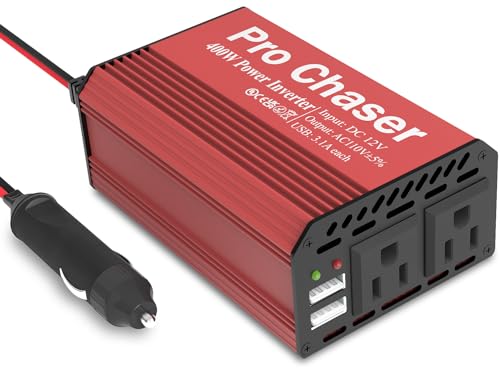
This compact inverter outputs 400W continuous power with 800W peak, featuring dual 110V AC sockets and dual USB ports. It’s ideal for travelers needing on-the-go power for laptops, breast pumps, DVD players, and other small appliances. Best for: families and travelers who want a compact, travel-friendly option. Limitation: not suitable for high-wattage appliances; monitor total draw to avoid tripping the inverter.
DEWALT DXAEPI140 Power Inverter

This 140W inverter provides continuous household power with a 25W USB-C and 15W USB-A ports, and a fan-free silent design. Best for: light-duty charging in travel scenarios where quiet operation is preferred. Better for: charging phones, tablets, small gadgets, and USB-C powered devices. Caution: do not run larger power tools or high-wattage appliances on this model.
Ampeak 150W Car Power Inverter

This 150W inverter converts 12V DC to 120V AC with 4.8A dual USB ports and one AC outlet. It emphasizes 11-layer protection and upgraded USB charging efficiency. Best for: car charging of laptops, phones, and small devices. Consider: may cap out for larger laptops or power-hungry devices; check device wattage before use.
Buying Guide
What should you prioritize when choosing a 120V inverter?
Continuous wattage vs. peak surge. Choose a model with a continuous rating that matches your typical load plus some headroom. The peak rating matters for short bursts when starting devices with higher inrush.
How many outlets do you need?
Consider how many devices you plan to run simultaneously. If you frequently charge laptops, tablets, and a router, pick an inverter with multiple AC outlets and multiple USB ports or PD USB-C for fast charging.
Do you need USB-C or PD charging?
PD USB-C ports enable faster charging for newer devices. If your devices rely on USB-C, prioritize models with one or more PD ports.
What about cooling and safety?
Look for built-in cooling fans or thermal protection for extended use. Also ensure protections for undervoltage, overvoltage, short circuit, and overheating to protect both inverter and vehicle electronics.
Portability and setup considerations
Assess size, weight, and cable length. Longer cords provide flexibility in larger vehicles, but add clutter. A compact unit is easier to store in daily use or emergencies.
Is a warranty or brand reliability important?
Well-known brands often provide clearer product support and more consistent performance. Review user experiences for real-world reliability and ease of use.
FAQ
- What does continuous wattage mean? It’s the steady power the inverter can supply without overheating. Choose a unit with a continuous rating at or above your typical load.
- Can I run a laptop on a 140W inverter? Yes, if the laptop’s power needs stay under the continuous wattage; otherwise use a higher-watt inverter.
- Is USB-C PD necessary for car charging? It’s beneficial for fast charging newer devices, but not essential for basic phones or tablets.
- Will an inverter drain my battery quickly? Higher continuous power will drain the battery faster. Plan usage and monitor load to preserve battery life on longer trips.
- Should I choose three outlets over two? If you frequently run multiple devices at once, three outlets increases flexibility, especially in family use scenarios.
- What safety features matter most? Overload, short-circuit, undervoltage, and overheat protections prevent damage to devices and vehicle electrical systems.