Direct answer: these 12 VDC to 120 VAC inverters convert a vehicle’s 12V battery power into standard household AC power, ideal for laptops, small appliances, and mobile setups. The best options balance continuous power, safety protections, and practical outputs like USB-C/USB-A charging. This guide highlights five top models to fit different needs—from compact car use to high-demand RV or mobile office setups—helping travelers, commuters, and campers choose confidently.
Below is a quick buying table of the featured products to compare at a glance.
- Pro Chaser 400W: Best for compact travel with dual USB and dual AC outlets.
- OLTEANP 500W: Better for road trips needing stable 500W with LCD readout.
- OLTEANP 1000W: Versatile for laptops and mid-size appliances on longer trips.
- LANDERPOW 3000W: Best for RVs, off-grid setups, and high-demand devices.
- BELTTT 2000W: Strong pure sine wave option with robust protections.
Pro Chaser 400W Power Inverter Review
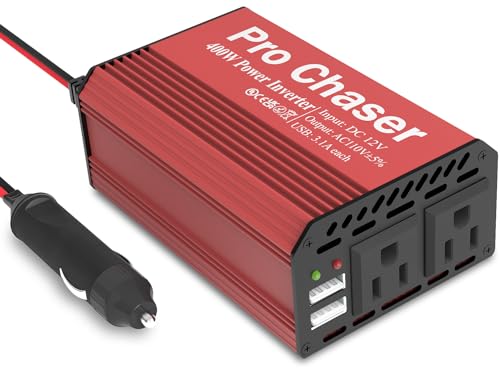
Key features: 400W continuous, 800W peak, dual 110V AC outlets, dual USB ports (3.1A), 30-inch cord. This model is designed for on-the-go power in cars and small travel setups, handling devices like laptops and media players during road trips.
Best for: Travelers who need a compact, easy-to-mount inverter with quick USB charging and dual outlets for common gadgets.
Caution: If you power high-wattage appliances near the 400W continuous limit, performance may slow during peak starts. Consider a higher-wattage unit for frequent surge needs.
OLTEANP 500W Power Inverter With LCD

Key features: 500W continuous, 110V/120V AC, 36W Type-C port, 5V/3A USB, built-in LCD display, safety protections. Suited for road trips and mobile offices, powering laptops and small electronics directly from a vehicle battery.
Best for: Users who want clear real-time status via the LCD display and a dedicated Type-C port for fast charging on the go.
Caution: Protection features are robust, but heavy multi-device loads above 500W can approach the limit; plan device usage accordingly.
OLTEANP 1000W Power Inverter

Key features: 1000W continuous, 2000W peak, 12V DC to 110/120V AC, LCD display, two AC outlets, USB-C/USB-A ports, safety protections. Designed for cars, trucks, and camping, capable of running laptops, TVs, and other mid-duty devices.
Best for: Those needing higher power capacity for longer work sessions or mid-size appliances while traveling.
Caution: The higher output increases heat; ensure adequate ventilation or cooling during prolonged use.
LANDERPOW 3000W Pure Sine Wave Inverter

Key features: 3000W continuous, 6000W surge, pure sine wave output, 3 AC outlets, USB-C 30W, USB 5V 3.1A, remote control, hardwire option. Suitable for RVs, solar setups, and off-grid use where stable, grid-like power is needed.
Best for: Heavy-duty power users who run multiple high-wattage devices, such as appliances or power tools, off a vehicle or off-grid setup.
Caution: Large inverter with multiple outlets and remote control may require careful installation and space planning in smaller vehicles.
BELTTT 2000W Pure Sine Wave Inverter

Key features: 2000W continuous, 4000W peak, dual AC sockets, 5V 2.1A USB, remote controller, hardwire port. Built for solar, RV, and truck use, with a pure sine wave output for sensitive electronics.
Best for: Users needing a strong, grid-like power source for home-style electronics and entertainment systems on the go.
Caution: Efficiency and heat increase with higher loads; ensure adequate cooling and consider a larger capacity if many devices run simultaneously.
Buying Guide: How to Choose the Right 12 VDC To 120 VAC Inverter
Power needs: Determine your continuous wattage and surge requirements. Pick a model with at least 20-30% more continuous wattage than your highest-load device, and a surge rating that exceeds startup spikes.
Output quality: For sensitive electronics, choose a pure sine wave inverter to minimize risk of hum, flicker, or damage. Modified sine wave units can work for simple devices but may cause issues with certain electronics.
Ports and plug types: Consider the mix of AC outlets (number and type) and USB ports (Type-C PD and USB-A). A port layout that matches your devices helps simplify setup.
Protection features: Look for undervoltage/overvoltage, overload, short-circuit, and overheating protections. An automatic cooling system is beneficial for extended use.
Installation and portability: If you plan to move the inverter between vehicles or use it in tight spaces, prioritize compact models with longer power cords. A remote control or hardwired option adds flexibility for stationary installations.
Cooling and efficiency: Inverters generate heat; units with effective cooling perform better under load. Efficiency impacts battery life during longer use sessions.
Reliability and data readouts: LCD displays that show input/output voltage, load, and battery status help manage operation and prevent unexpected shutdowns during trips.
Frequently Asked Questions
- What size inverter do I need for laptop charging? A 300–1000W inverter typically covers laptops and accessories, depending on the laptop’s power draw and charging requirements.
- Is a pure sine wave inverter necessary? Yes for sensitive electronics and appliances with motors or compressors; it reduces risk of noise and equipment stress.
- Can I run a microwave or air conditioner from a car inverter? Most 12V to 120V inverters are not suitable for high-wattage appliances like microwaves or AC units unless you choose a very high-wattage model with robust cooling and safety features.
- Will an inverter drain my vehicle battery quickly? Yes, especially under heavy load or when the engine is off. Use a battery protection feature and avoid prolonged high-wattage use without a charging source.
- How do I connect an inverter safely in a car? Use proper cabling, avoid modifying vehicle electrical systems, and ensure ventilation to prevent overheating.
- What maintenance is needed? Check cables, vents, and connectors regularly; keep the unit clean and ensure cooling fans operate when under load.