Choosing a reliable 12 kW portable generator provides peace of mind during outages, storms, or outdoor work sites. The following selected models balance power, fuel flexibility, and user-friendly features like electric start, transfer-switch readiness, and CO detectors. Whether you need dual-fuel versatility or tri-fuel options, these generators are designed to keep essential circuits powered while offering safe operation and straightforward maintenance.
| Product | Brand | Fuel Options | Key Feature |
|---|---|---|---|
| Westinghouse 12500 Watt Dual Fuel | Westinghouse | Gasoline, Propane | Remote start, transfer switch ready |
| Generac 12,500 Starting Watt Tri-Fuel | Generac | Gasoline, Propane, Natural Gas | COsense CO detection, electric start |
| WEN 11,000-Watt Dual Fuel | WEN | Gasoline, Propane | Dual voltage 120/240V, electric start |
| DuroStar DS13000MXT Tri Fuel | DuroStar | Gasoline, Propane, Natural Gas | CO shutdown, transfer switch ready |
| Westinghouse 14500 Peak Watt Tri-Fuel | Westinghouse | Gasoline, Propane, Natural Gas | High peak watts, long runtime |
Westinghouse 12500 Watt Dual Fuel Backup Generator

The Westinghouse model delivers 9500 running watts on gasoline and 8500 running watts on propane, with peak outputs up to 12500 watts gasoline and 11200 watts propane. It features remote start via a key fob, electric and recoil start, and a fuel tank that runs up to 12 hours. It includes two GFCI 120V outlets, a 30A transfer switch outlet, and an RV-ready 50A receptacle. A 457cc engine with automatic low oil shutdown and a digital hour meter supports long-term reliability. The VFT display shows real-time voltage, frequency, and hours.
Generac 12,500 Starting Watt Tri-Fuel Generator

The Generac tri-fuel unit accommodates gasoline, propane, or natural gas with a fuel selector dial. It offers a push-button electric start with a rechargeable battery for quick power activation. The 500cc OHV engine enables longer runtimes, with up to 9.5 hours at 50% load on gasoline. It is designed for emergency home backup and can support a wide range of appliances and circuits during outages.
WEN 11,000-Watt Dual Fuel Portable Generator
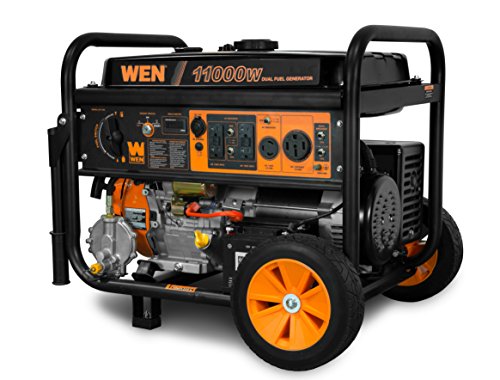
The WEN DF1100T offers 8,300 running watts on gasoline and 7,500 running watts on propane, with surge wattage up to 11,000 and 9,500 respectively. It provides 120V and 240V output options, ideal for transfer switches and emergency backups. An electric start powers a 457cc OHV engine for quick operation, supported by wheel kit portability for easier relocation during outages or outdoor tasks.
DuroStar DS13000MXT Tri Fuel Generator

The DS13000MXT delivers 13,000 watts on gasoline and 50A transfer switch-ready capacity along with tri-fuel flexibility (gasoline, propane, natural gas). It emphasizes safety with CO alert and a robust power panel, including a push-button start and a variety of outlets designed for home backup and emergency use. This model targets larger homes or areas with higher electricity demands during outages.
Westinghouse 13500 Peak Watt Dual Fuel

With 10500 running watts on gasoline and 9500 running watts on propane, this unit offers a 13500 peak watt output. It includes remote start with a key fob and a 30A transfer switch outlet plus an RV-ready 50A receptacle. A 500cc Westinghouse engine and a long runtime on a sizeable fuel tank make it a robust option for combined residential and outdoor power needs, backed by safety features such as rubber outlets covers and a digital hour meter.
Westinghouse 14500 Peak Watt Tri-Fuel

This tri-fuel powerhouse lists 11,500 running watts on gasoline, with a 14,500 peak watt capacity, and alternative performance with propane or natural gas. It runs up to 19 hours on a 9.5-gallon tank and includes multiple receptacles, a 50A transfer switch outlet, and a robust 550cc Westinghouse engine. It targets high-demand home backup scenarios where extended operation is needed.
Buying Guide: Key Purchase Considerations
- Fuel flexibility: Tri-fuel or dual-fuel options provide versatility during fuel shortages or outages. Consider the availability and cost of gasoline, propane, or natural gas in your area.
- Power and runtime: Match wattage to your essential circuits (refrigeration, heating, sump pumps, lights). Look at running watts for practical needs and peak watts for startup surges. Runtime at a typical load indicates how long you can operate between refuels.
- Starting method: Electric start is convenient in emergencies; recoil start is a backup. Some models include remote start via key fob for quick activation from a distance.
- Transfer switch compatibility: If you plan to power a whole home panel, ensure the unit is transfer switch ready and compatible with your electrical setup.
- Safety features: CO sensors, automatic low-oil shutdown, and rubber outlet covers reduce risk. CO shutdown is especially important in enclosed or semi-enclosed spaces.
- Portability and size: Wheel kits and compact framing improve maneuverability, but larger units require secure storage and adequate ventilation for safe operation.
- Noise and location: Consider day-to-day noise levels and plan for outdoor installation away from living spaces. Follow local codes for generator placement and exhaust.
- Maintenance and warranty: Check engine type, oil requirements, service intervals, and warranty terms. Models with digital hour meters help track maintenance schedules.
When evaluating options, align features with anticipated use—whether for storm outages, job sites, or RV camping—and factor in local fuel availability and space constraints. All listed models provide substantial power with multiple outlets and safety features suitable for medium to large homes and backup scenarios.