Discover compact, solar-powered generators designed to keep essential devices running when you’re off the grid. The following selections focus on 100W-class output with scalable panels, suitable for camping, emergencies, and travel. Each option lists portability, charging options, and practical outputs to help you compare performance and value.
Summary Of Chosen Products
| Product | Brand | Key Benefit |
|---|---|---|
| Solar Powered Generator With Panels Included | Apowking | 146Wh capacity, 7 outputs, includes a 40W solar panel |
| Solar Generator 300 With Solar Panel | Jackery | 293Wh battery, 110V/300W AC, fast recharge |
| Portable Power Station With Foldable Panel | ZeroKor | 100W panel included, multiple charging ports |
| Portable Power Station 28,000mAh LiFePO4 | DARAN | Small footprint, 100W output, LiFePO4 chemistry |
| Anker Solar Generator SOLIX C300 | Anker | 300W AC, 288Wh, two-way fast charging |
Apowking 146Wh Portable Solar Power Station With 7 Outlets

The Apowking setup combines a compact power station with a 40W solar panel. Its monocrystalline 20.5% efficiency enhances charging under limited sunlight. The system weighs about 3.3 lb, making it highly portable for outdoor activities. It includes a 146Wh/39,600mAh battery and seven outputs, including two 110V AC outlets, multiple USB ports, and a DC 12V output. This arrangement supports laptops, phones, cameras, and small appliances on trips or during emergencies.
Jackery Solar Generator 300 With 100W Panel

The Jackery option provides a robust 293Wh lithium battery with 2 Pure Sine Wave AC outlets delivering up to 300W continuous power. It supports a rapid recharge cycle, including a 60W USB-C input/output port and the SolarSaga 100W panel for off-grid charging. The unit weighs about 7.1 pounds, combining portability with sufficient capacity for camping, RV use, or emergency power. It is designed to support multiple devices concurrently, including drones, laptops, and cameras.
ZeroKor Portable Power Station With 40W Panel
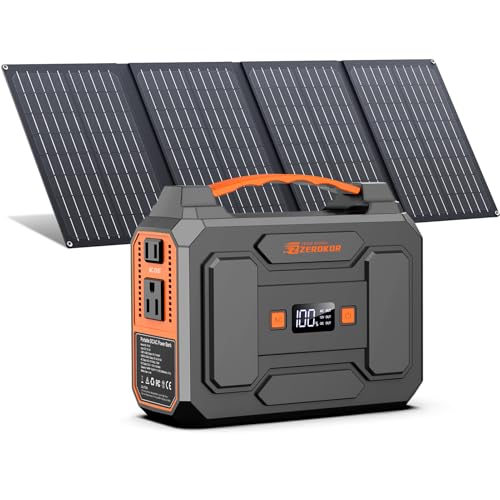
ZeroKor combines a 100W portable power station with a foldable 40W solar panel. It offers multiple charging outputs, including two 110V AC outlets up to 100W, several USB ports, and a DC output. The design emphasizes versatility, with USB-C and QC ports for fast device recharging and an onboard flashlight with SOS mode for emergencies. The kit supports wall, car, and solar charging, appealing to campers and off-grid enthusiasts who need flexible power access and compact storage.
DARAN Portable Power Station With 28,000mAh LiFePO4 Battery

The DARAN unit emphasizes a compact footprint with LiFePO4 chemistry for enhanced longevity. It delivers 100W continuous power and 200W peak, with seven output options including two AC sockets, USB-C, USB-A, and DC ports. The unit’s slim profile and light weight make it easy to carry in a backpack, while the internal battery supports rapid charging via multiple inputs. It is suitable for mobile charging of laptops, phones, and small devices during outdoor activities or power outages.
Anker SOLIX C300 Solar Generator Kit

The Anker SOLIX C300 packs 288Wh of LiFePO4 storage and delivers up to 300W continuous power with a 600W surge. It includes 140W two-way fast charging via USB-C, enabling rapid recharging of both the power station and connected devices. Eight charging ports cover AC, USB-C, USB-A, and car ports, providing versatile options for diverse electronics. The unit is designed to be travel-friendly, with a lighter footprint relative to its power output and a practical carrying approach for outdoor use and emergencies.
Buying Guide
Key purchase considerations help compare 100W-class solar generators across brands and use cases:
- Power needs: Assess your typical devices. For laptops, cameras, or small appliances, prioritize higher continuous wattage (100W+) and multiple AC outlets. For phones and lights, USB-C PD and USB-A ports may suffice.
- Battery chemistry: LiFePO4 cells offer longer life and better thermal stability, but may increase weight. Consider expected cycles and long-term durability for off-grid use.
- Solar panel integration: Some kits include panels; others require separate purchases. Check panel efficiency (typically 18–23%) and compatibility with multiple chargers or generators.
- Port variety: A mix of AC, USB-C, USB-A, and DC outputs provides flexibility for different devices and charging speeds. Look for USB-C PD (Power Delivery) for faster recharging of laptops and phones.
- Charging methods: Evaluate if the unit supports simultaneous charging from AC, solar, and car outlets. This reduces downtime when off-grid.
- Portability and weight: If you’ll carry the unit in a backpack, weight and dimensions matter. Slim designs and integrated handles improve transportability.
- Durability and safety: Consider protective features, battery management systems, overcharge/discharge protection, and temperature handling for outdoor uses.
- Use-case alignment: For emergencies, prioritize reliability and ease of use. For camping or RV trips, panel-inclusive kits with higher wattage outputs can be advantageous.
- Warranty and support: Check manufacturer warranties and availability of customer support for troubleshooting and accessory compatibility.
- Price vs performance: Compare total energy capacity (Wh), peak versus continuous output, and included accessories to gauge overall value for your needs.
Overall, the best choice depends on your balance between portability and power. Higher wattage models with more ports offer flexibility for multiple devices, while compact options prioritize lightness and ease of transport for quick trips or emergencies. Review the included accessories and ensure compatibility with your typical devices to maximize the utility of any 100W-class solar generator.