Finding a reliable 100 MHz signal generator is essential for testing, debugging, and validating electronic designs. This guide highlights five capable devices that offer precise DDS or DDS-like performance, dual channels, and versatile waveform options. Each product below aligns with the demand for stable, high-quality output signals suitable for lab and field work. And for quick reference, see the buying table summarizing core specs and capabilities.
| Product | Max Frequency | Channels | Key Feature | Approx. Sample Rate |
|---|---|---|---|---|
| Koolertron DDS Signal Generator Counter | 80 MHz | 2 | Large FPGA core with mobile app control | 275 MSa/s |
| Signal Generator DGE2070 Arbitrary Waveform Generator | 70 MHz | 2 | Extensive waveform library and modulation | 300 MSa/s |
| Koolertron Upgraded 15MHz DDS Generator | 15 MHz | 2 | Dual-channel precision with wide waveform options | 200 MSa/s |
| FNIRSI 2D15P 100MHz DDS Generator & Oscilloscope | 100 MHz | 2 | 3-in-1 scope/multimeter/generator | — |
| FNIRSI 1014D Oscilloscope with DDS Generator | 100 MHz | 2 | High sampling and storage in one device | — |
Koolertron DDS Signal Generator Counter

The Koolertron DDS Signal Generator Counter combines a large-scale FPGA-driven architecture with a high-speed MCU, delivering stable, low-distortion waveforms. It supports dual channels with independent parameter settings and offers a range of waveforms including sine, square, triangle, sawtooth, pulse, white noise, and user-defined options. A mobile app can control the device, view data, and enable import/export of arbitrary waveform data, enhancing usability for field work and bench testing.
Signal Generator DGE2070 Arbitrary Waveform Generator

The DGE2070 offers dual-channel waveform generation up to 70 MHz with a 300 MSa/s sample rate and 14-bit vertical resolution. It includes 8K arbitrary waveform length and 150 built-in waveforms, plus extensive modulation options such as AM, FM, PM, FSK, sweep, and burst. A user-friendly interface covers brightness settings, screen saver, language selection, and USB device compatibility, making it suitable for precise lab experiments and automated testing setups.
Koolertron Upgraded 15MHz DDS Signal Generator Counter

The upgraded Koolertron model targets dual-channel DDS functionality with frequencies up to 15 MHz and 200 MSa/s. It emphasizes stable, low-distortion outputs across common waveforms (sine, square, triangle, sawtooth, pulse, noise) and supports independently set parameters per channel. Additional features include linear and logarithmic sweep options, plus integrated frequency and period measurement for quick signal validation in development and testing workflows.
FNIRSI 2D15P 100MHz DDS Oscilloscope Generator

FNIRSI 2D15P combines a 100 MHz DDS signal generator with a two-channel oscilloscope and multimeter in one unit. It features a 4.3-inch touchscreen, 500 MS/s sampling, and up to 19,999 TRMS counts for diagnostics. With auto-measurement capabilities for AC/DC voltage, resistance, and more, this device enables comprehensive signal capture and quick waveform analysis alongside its DDS capabilities.
FNIRSI 1014D Oscilloscope with DDS Generator
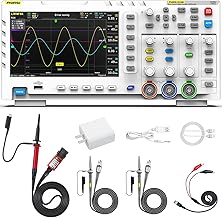
The FNIRSI 1014D integrates an oscilloscope with a DDS signal generator, delivering 100 MHz bandwidth and 1 GSa/s sampling. It includes 2 channels, built-in storage, and a robust set of measurement and analysis tools. The device supports Chopping output and 14 DDS signal types, making it a compact solution for engineers needing both signal generation and diagnostic capabilities in a single instrument.
Buying Guide
- Bandwidth and frequency range: Match the device’s maximum frequency to your testing needs. For 100 MHz targets, devices listed here either meet or approach that limit; verify actual usable range and any waveform integrity at high frequencies.
- Output accuracy and resolution: Look for high sample rates (MSa/s), vertical resolution (bits), and low distortion specifications to ensure clean signal generation for precise testing and calibration.
- Number of channels and independent control: Dual-channel units enable simultaneous testing of two signals or differential testing. Check if channels can be tuned independently and if synchronization features exist.
- Waveform library and customization: A broad library (sine, square, triangle, sawtooth, pulse, noise) plus user-defined waves improves versatility. Consider the ease of importing/exporting custom waveforms.
- Modulation and sweep capabilities: AM, FM, PM, FSK, and frequency sweeps (linear/logarithmic) expand test scenarios. Assess sweep duration, start/stop frequencies, and sweep steps.
- Connectivity and control: USB, app-based control, and on-device menus affect workflow. Mobile or PC control can streamline automated testing and data logging.
- Oscilloscope and multimeter integration: If you need observation and measurement in one tool, devices combining DDS generation with oscilloscope capabilities can save space and costs.
- User interface and support: A clear UI, screen brightness controls, language options, and accessible documentation reduce the learning curve for new users.
- Portability and build quality: For field use, consider weight, power options, and physical robustness. Lab setups may prioritize a larger display and extended storage.