Looking for the right flush cut router bit for clean trimming and pattern routing? This guide highlights 5 reliable options ideal for different materials and projects. Each pick is best for specific buyers—whether you’re a hobbyist, a professional cabinetmaker, or someone working with plywood, hardwoods, or laminates. The table below summarizes key details to help you compare at a glance.
| Product | Best For | Shank | Cut Type | Approx. Length |
|---|---|---|---|---|
| Freud 42-100 | General trimming on solid wood and plywood | 1/4″ | Bearing flush trim | 2-13/16″ |
| Wolfride 4PCS | Versatile set for multiple diameters | 1/4″ | Top bearing flush trim | Varies by cutter |
| Jiiolioa 2 PCS | Down cut flush trimming | 1/4″ | Down cut | Not specified |
| EANOSIC Downcut | High-precision edge profiling | 1/4″ | Down-cut, top bearing | 1″ |
| HARFINGTON 2pcs | Durable carbide for particleboard & plywood | 1/4″ | Flush trim with top bearing | ~2.8″ |
Freud 42-100: 3/8″ Bearing Flush Trim Bit
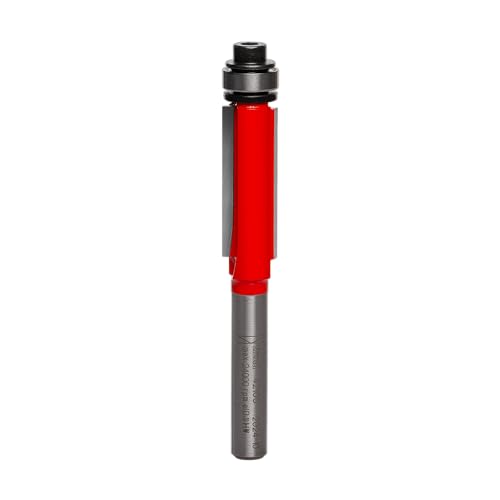
The Freud 42-100 offers a 3/8″ bearing diameter with a 1/4″ shank and a 3/8″ overall diameter. It features two cutters and a 2-13/16″ overall length, making it versatile for trimming plywood, hardwoods, and softwoods. Best for hand-held or table-mounted routers. This bit is suited for general trimming tasks where a stable bearing guides the cut. A potential limitation is the larger diameter bearing which may require matching setup spacings on intricate profiles.
Wolfride 4PCS Flush Trim Router Bit Set
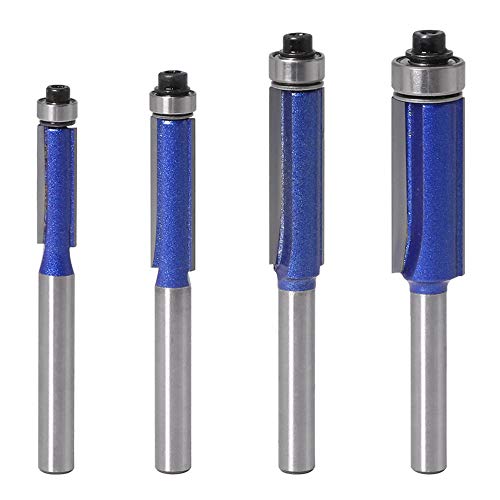
This 4-piece set provides a range of diameters with a 1/4″ shank and top bearing. Cutting diameters include 1/4″, 5/16″, 3/8″, and 1/2″. Industrial-grade carbide cutters and precision ground edges deliver smooth surfaces and long service life. Best for crafters who need multiple flush-trim options without changing bits. A limitation to watch is that the set requires careful matching of cut depth to diameter for optimal edge quality.
Jiiolioa 2 PCS Flush Cut Trim Router Bits

Jiiolioa offers 2 flush-cut bits with 1/4″ shanks designed for down-cut trimming. They’re suitable for soft and hard woods, plywoods, composites, laminates, and plastics. The bits are precision-ground for balanced performance at higher RPMs. Best for clean edges on board faces where tear-out must be minimized. A caveat is that down-cut bits can sometimes leave a slightly different surface texture on certain laminates compared to up-cut variants.
EANOSIC Downcut Flush Trim Router Bit
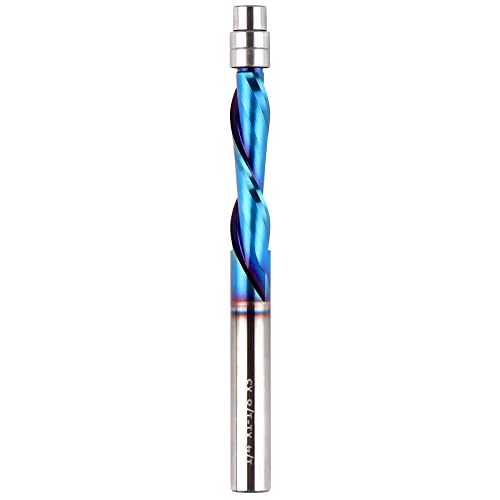
EANOSIC’s downcut flush trim bit features a 1/4″ shank and 1″ cut length. Built with virgin carbide and a blue nano coating, it emphasizes edge sharpness and heat resistance. The dual-bearing design helps maintain stable cuts with reduced vibrations. This bit is best for high-precision trimming and edge profiling on demanding projects. A limitation is that coated bits can wear differently than uncoated tools, requiring occasional replacement to maintain sharpness.
HARFINGTON 2pcs Flush Trim Router Bit Set
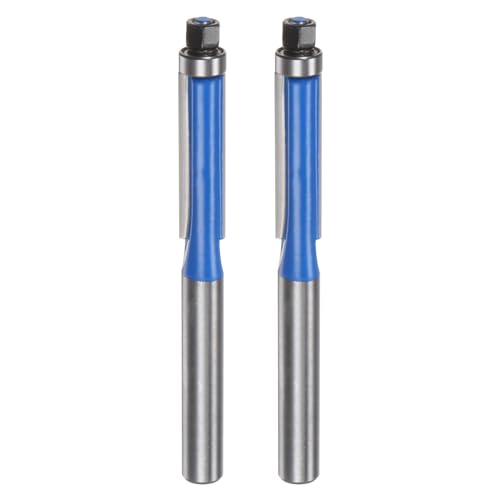
HARFINGTON offers a 2-piece carbide set with 1/4″ shanks and 1/4″ cutting diameters, plus a 1″ cutting depth. The bits are designed for particleboard, plywood, MDF, and other woodwork materials. A top bearing facilitates flush trimming, and a coating reduces friction and heat buildup. Best for budget-conscious professionals or hobbyists. A limitation is a relatively modest cutting depth at 1″, which may require multiple passes for thick stock.
Buying Guide
What matters most when choosing a flush trim router bit? Consider material, bearing arrangement, and shank compatibility. For dense hardwoods, look for carbide-grade cutters and coatings that reduce heat. If you frequently switch between materials like plywood and laminates, a multi-diameter set can save time. Down-cut bits minimize tear-out on the top surface, while up-cut variants can produce cleaner edge profiles on the bottom surface.
Material And Coating
Carbide carbide-grade bits with nano coatings resist heat and maintain sharpness longer. Coatings like blue nano NiCo help extend life and reduce friction, but may wear differently than uncoated bits. For soft woods and plywoods, standard carbide bits are typically sufficient.
Bearing Type And Alignment
Top bearings guide flush trimming along the edge, while bottom bearings can improve control on certain profiles. Dual-bearing designs (as seen on some EANOSIC and SHARPRO options) reduce deflection and vibration, improving edge quality at higher speeds.
Diameter And Shank Compatibility
Most ¼” shank bits are compatible with common routers. Ensure the bit diameter matches your project needs; larger bearings offer stability but may require more clearance. For pattern routing or edge shaping, choose a diameter that aligns with your planned cut depth and material thickness.
Durability And Application
Down-cut bits excel at minimizing tear-out on the top surface but can push chips downward, which matters for certain workpieces. Up-cut variants may give cleaner bottom edges in some laminates. For particleboard or MDF, look for solid carbide with robust bearings to withstand wear.
Practical Buyer Scenarios
- Hobbyist woodworking with a mix of plywood and softwoods: Wolfride 4PCS offers versatility and value.
- Cabinetry or plywood edging: Freud 42-100 provides reliable trimming with a durable bearing.
- Fine pattern routing and tear-out minimization: SHARPRO or HARFINGTON sets address safety and smooth finishes.
- High-precision edge profiling on hardwoods: EANOSIC Downcut delivers longevity with nano-coated carbide.
FAQ
- What is flush trimming used for?
Flush trimming removes excess material along the edge to ensure a flush surface with the adjacent piece.
- Should I choose a down-cut or up-cut bit?
Down-cut bits reduce tear-out on the top surface; up-cut bits can leave a cleaner bottom edge. Your choice depends on the workpiece and desired finish.
- Is a top bearing necessary?
Top bearings guide the cut along the edge, making flush trimming easier and more accurate for most applications.
- Do coatings affect performance?
Yes. Nano coatings improve wear resistance and reduce heat buildup, extending life in high-RPM use, but performance can vary with material and feed rate.
- Can I use these bits on a handheld router?
Yes. The majority are designed for both handheld and table-mounted routers, depending on bit diameter and shank compatibility.
- How many passes are typically needed?
Most flush-trim tasks can be completed in one pass if the stock is properly secured and the bit diameter matches the cut depth. Complex profiles may require multiple passes.